NFL London Games Betting UK: Stadiums and Travel Edges
 Available in US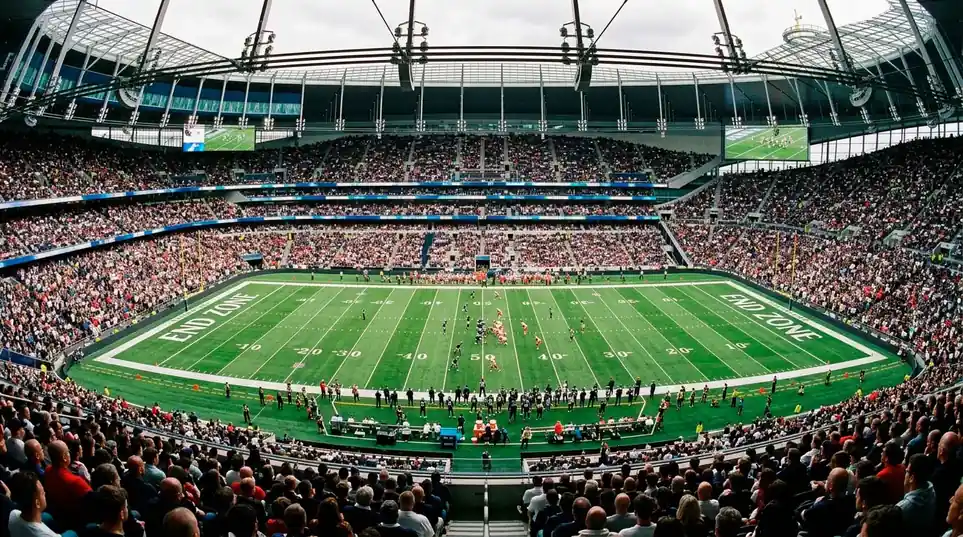
NFL London Games Betting Dynamics and Spread Records
The first time I watched an NFL game at Wembley with a betting slip in my pocket, I made a mistake that, embarrassingly, I made twice more before I learned. I bet the designated home team because I assumed the crowd would do its job. The crowd did its job — Wembley was loud, the place was rammed — but the crowd was not, in fact, made up of partisans the way a Sunday in Kansas City is. It was a tourist crowd in NFL terms. Half the stadium was there for the spectacle, not for one team. That changes the betting calculation in ways UK punters often miss.
London Games are a microclimate. The same teams, the same officials, the same rulebook — but a different stadium, different travel pattern, different crowd, different kickoff time, and a designated home team that is in no meaningful sense at home. The 2025 international slate confirmed how much of a thing this has become: London hosted three regular-season games, total London fixtures since 2007 surpassed 42, and across the world the league fielded a record seven international games. If you’re betting NFL from the UK, this is the slate you have local advantage on. Use it well.
The 2025 London fixtures and what they revealed
The 2025 London games were the Vikings, Browns, and Jaguars trio at Tottenham Hotspur Stadium and Wembley, part of a wider international expansion that also took regular-season football to Dublin, Berlin, Madrid, and São Paulo. The lineup was the kind of mix that makes London Games betting tricky: a marquee draw, a developing roster, and the franchise that has effectively adopted the city. The full international footprint of seven games marked the most regular-season football the NFL has ever played outside the United States in a single year.
Henry Hodgson, the NFL’s UK and Ireland general manager, framed it specifically when announcing the 2025 schedule: the Jets, Browns, and Jaguars all coming to London was meant to push the capital past 40 cumulative regular-season games, which it duly did. That cumulative weight matters for bettors because it gives us a real sample to work from. London Games are not novelty contests anymore. They have history, patterns, and quirks that show up in line behaviour week after week.
What I look for in the slate before placing any London bet: kickoff time (the 14:30 GMT and 18:30 GMT windows behave differently on totals), which team is the designated home side, how each side travelled, and whether either team has a quarterback situation that pre-game medical reports might still affect. The international slate compresses preparation, and that compression is reflected in spreads that occasionally drift more than you’d expect in a domestic fixture.
Tottenham versus Wembley as betting venues
Both venues hold an NFL crowd well, but they are not interchangeable. Tottenham Hotspur Stadium was purpose-built with NFL hosting in mind — the retractable pitch, the dimensions, the locker rooms, the broadcast positions — and the surface plays differently to Wembley. Wembley is a football stadium first, and the pitch dimensions are tighter for an American football field, which has historically pushed marginally higher totals due to easier red-zone access on a slightly compressed playing surface.
The atmosphere is also distinct. Wembley delivered the all-time NFL London attendance record of 86,651 for Jaguars-Patriots in October 2024 — the kind of number that makes designated home teams feel a real crowd lift even when the partisan split is closer to fifty-fifty. As Henry Hodgson put it when confirming the 2025 slate: welcoming the Jets, Browns, and Jaguars to London formed part of surpassing the 40-game milestone, and the venues themselves are now part of the league’s permanent international infrastructure.
From a betting perspective, I treat Wembley as marginally more favourable to offences and to higher totals, and Tottenham as the more neutral surface. Neither is strongly home-advantageous in the American sense, which is the bigger point: when a UK book applies a “home” designation to a London Game, you should generally fade the implied home bump unless the team’s actual fanbase has travelled in numbers, which the Jaguars are the only franchise to reliably do.
The home-field effect on neutral soil
Standard NFL home-field advantage is worth somewhere in the region of two to three points on the spread, give or take depending on the stadium and the era. London strips most of that out. The designated home team is sleeping in a hotel, eating in a hotel, training at a borrowed facility. The crowd is broadly neutral with pockets of partisan support. Officiating is unaffected by venue. None of the soft factors that produce home-field advantage in Buffalo or Seattle are operating at full strength in London.
What I take from this: when a UK book opens a London spread that looks like it has the standard home-field bump baked in, that’s an opportunity. The implied advantage often shouldn’t be there at full size. The exception is the Jaguars, who genuinely import a home crowd to London, but even that is partial — they’re not playing in front of 60,000 Jacksonville season-ticket holders.
If you want the deeper structural argument for why the home-field number has been shrinking generally and why neutral sites are an even more aggressive case of that shrinkage, my breakdown of how home-field advantage gets priced into NFL betting models goes into the historical 2.5-point figure and how it has eroded since 2020. The London Games are essentially the extreme end of that trend.
Jet lag, travel, and the betting factors nobody talks about
The other side of the coin: London-based bettors have an information advantage on jet-lag effects that American sharps often miss or underweight. Teams travel transatlantic on a Thursday or Friday, lose half a day to the flight and the time zone, and play a major sporting event with the body still adjusting. The data on whether this measurably hurts performance is genuinely mixed — coaches have refined the routine over almost 20 years of London hosting — but it certainly affects fourth-quarter conditioning and kicking accuracy more than first-quarter scoring.
The kickoff slot matters here. The 14:30 GMT slot is roughly 9:30 AM body-clock time for the visiting team — a kickoff before they would normally have eaten breakfast in any practical NFL sense. That’s measurably an issue for offences that rely on rhythm and timing. The 18:30 GMT slot is closer to a familiar early-afternoon window for the visitors, and the lines tend to behave more like a domestic fixture in that slot. I look at totals more aggressively in 14:30 windows, on the under, and I’m more cautious in 18:30 windows where the body-clock penalty is smaller.
The other practical factor: returning teams the following week. NFL schedules increasingly give visiting London teams a bye after the international fixture, which removes one of the historical drags. When that bye is absent, the following week’s totals often deserve a second look — fatigue isn’t fully resolved by Tuesday after a transatlantic trip.
Are the designated home team odds biased at London Games?
They often are, in a way that benefits sharp bettors. UK books sometimes apply something resembling a normal home-field bump to the designated home team, even though the practical advantages of being at home — sleep, food, routine, partisan crowd — are mostly absent in London. The exception is when the Jaguars are designated home, since their UK fanbase genuinely travels in numbers. Otherwise, fading some or all of the implied home advantage is a defensible angle on London spreads.
Does kick-off time in London affect totals lines?
Yes, and it shows up most clearly in the 14:30 GMT slot, which corresponds to a body-clock time of around 9:30 AM for the visiting American team. Offences are typically slower to find rhythm in that window, and totals lean towards the under more often than in the 18:30 GMT slot, where the visiting team is closer to a familiar afternoon kickoff.
What is the historical record of London Games against the spread?
Across the cumulative 40-plus regular-season London fixtures since 2007, the historical record against the spread has been roughly even, with no decisive edge for either favourites or underdogs over the long sample. The interesting patterns sit underneath that headline: home dogs in London have historically performed reasonably well, and the 14:30 GMT under has shown up more often than chance would suggest.
Published by the nfl Betting ods team.