NFL In-Play Betting UK: Live Lines and Market Odds
 Available in US
NFL In-Play Betting Latency and Live Odds Updates UK
Sunday night football, a few seasons back, watching on my laptop with a UK sportsbook open on my phone. Late field goal attempt to push a total over the close number. I saw the kick split the uprights, opened the bet slip, tapped to bet the over before the next snap, and watched the bet “suspend” before I could confirm. The book had already pulled the line. By the time the over reopened, the price was nothing like what I’d been about to take. That was the night I properly understood that in-play NFL betting is not the same as live betting on a soccer match. It moves differently, freezes differently, and rewards a different kind of attention.
In-play NFL has exploded as a product, and not just because UK punters love it. Live and in-play action accounted for over 60 percent of all online soccer bets in Europe in 2024, and the same trend has been pulling NFL with it — the more time-segmented the sport, the more in-play markets the book can offer between snaps and between drives. With mobile share of European online betting sitting at 78 percent, the entire in-play product is built for someone holding a phone in one hand while the broadcast plays in the other. That’s the format. Let me explain how it actually works.
How live pricing works between snaps
The book is running a model. That model takes in score, time remaining, down and distance, field position, possession, time-outs left, and weighs them through a pricing algorithm calibrated on historical NFL outcomes. Every play that happens — every yard gained, every clock tick, every penalty — feeds into the model, and the model spits out updated probabilities for the moneyline, the live spread, the live total, the next-score market, and a dozen other in-play offerings.
The model isn’t running in your phone. It’s running on a book’s servers, with a delay between the actual play and the updated price hitting your screen. Add the broadcast delay between live action and what you see on your TV — typically 5 to 10 seconds for a UK feed — and you’ve got a meaningful gap between what’s happening and what you’re betting on. Sharp in-play bettors exploit that gap. Casual ones get exploited by it.
The mechanics are also more honest than they look. When a book “suspends” a market mid-game, it’s not being cute. The model is recalibrating after a significant event — a turnover, an injury, a momentum-shifting play — and the book doesn’t want to take action at a stale price while it figures out the new one. The market typically reopens within 15 to 30 seconds at a meaningfully different number. Your job is to know which side of that reset you actually want, before the suspend happens.
Popular in-play markets and what they offer
The full menu of NFL in-play markets has gotten genuinely deep at UK books over the last few seasons. Beyond the obvious live moneyline, live spread, and live total, you’ll typically see:
Drive-level markets. Will the current drive end in a touchdown, field goal, or no score? These are the fastest-cycling in-play markets and the ones most affected by latency, because a single play can resolve them.
Quarter and half markets. Live spreads and totals just for the rest of the current quarter or half. These behave like compressed versions of full-game markets and price in pace and momentum more aggressively.
Next-score markets. Which team scores next, and how. Touchdown, field goal, safety, or no further scoring — these often offer wider prices than the equivalent full-game outcomes because the variance is higher.
Player-prop in-play markets. Will quarterback X throw for over Y yards in the rest of the game? Will running back Z score a touchdown in the second half? These are the highest-juice in-play markets and the ones books push hardest, partly because their hold matches the same 15-percent-plus profile that has made parlay handle account for around 22 percent of US sportsbook action.
The market depth tells you something about where the books make money. The lower the public’s understanding of how a market is priced, the higher the overround. In-play props are often where the gap is widest.
Latency and the bet delay
Every UK book runs a brief acceptance delay on in-play submissions — typically 1 to 5 seconds. You tap “place bet”, and the book holds the wager in a kind of pending state while it confirms the price hasn’t moved or that no significant event has just happened. If the price has moved against you, you typically get a “price has changed, accept new price?” prompt. If a play has just happened, your bet may be rejected entirely.
This isn’t a conspiracy against punters; it’s a sensible operational protection. Without a delay, a sharp bettor with a faster broadcast feed than the book’s pricing model could reliably extract money on every meaningful play. The delay closes that arbitrage. It also means recreational bettors get the occasional rejection on a bet they thought they’d placed cleanly, which is annoying but is the price of the product working as intended.
Two practical implications. First, never assume an in-play bet is placed until the slip confirms it. The window between tapping and confirmation is real and rejection is normal. Second, the broadcast delay matters more than the bet delay. A standard UK feed runs anywhere from 5 to 30 seconds behind the actual play, depending on streaming versus terrestrial broadcast. The book’s model is closer to live than your TV is. You are, on every in-play bet, slightly behind the book — and the book is happy to take your action with that asymmetry baked in. The mobile share of betting in Europe — 78 percent — also means the typical bettor is on a mobile data connection that adds further latency between the book and the bettor.
Live betting on London kick-offs
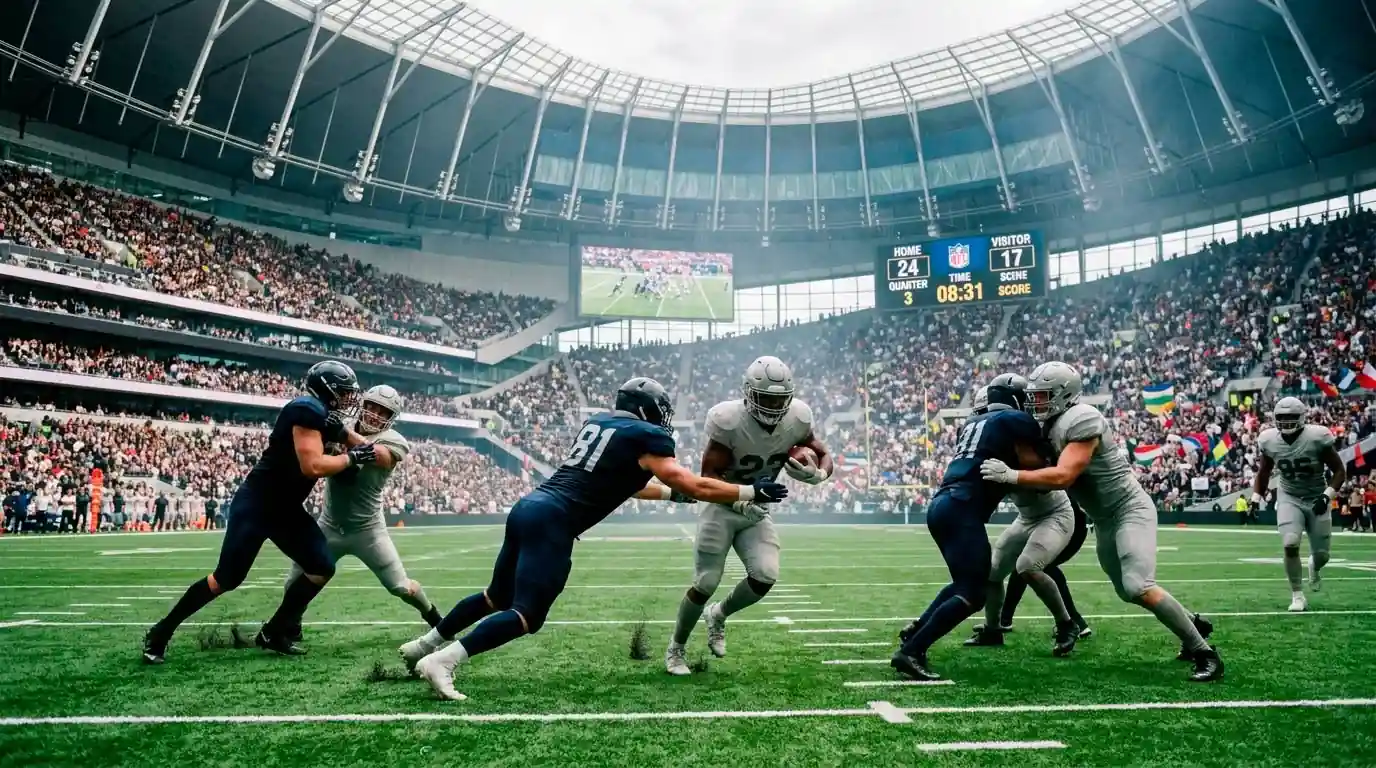
In-play NFL betting on London Games is a slightly different experience than on a Sunday US slate, and worth thinking through if you’re a UK punter. The kickoff windows are 14:30 GMT and 18:30 GMT, which means you’re betting in real time without the late-night fatigue that often clouds judgement on a Sunday Night Football in-play session.
The crowd is a useful tell. London Games crowds are loud but not partisan in the same way US crowds are, which means momentum swings are slightly less amplified by atmosphere. Markets like “will the home team score first” are subtly mispriced when they assume a normal home-field bump that London Games largely strip out.
The other dynamic worth knowing: London Games are often broadcast on Channel 5 in the UK now, after the multi-year free-to-air partnership announced for the 2025 season — and the broadcast latency on terrestrial UK television is meaningfully longer than on a sportsbook’s pricing model. If you’re betting in-play while watching free-to-air rather than on a streaming feed, you are even further behind the book than usual. Adjust your urgency accordingly. Don’t try to bet snap-to-snap on terrestrial; the latency is too punishing. Bet on drive-level resolutions or quarter-level markets where 30 seconds of broadcast delay matters less.
One last detail. Cash-out behaviour is closely tied to in-play pricing — you can’t cash out on a market that’s suspended, and the offered cash-out price is essentially a reflection of the book’s current live odds with their margin layered in. My breakdown of how NFL cash-out actually works goes into the mechanics of when offers are pulled and why.
Why does a live NFL line freeze for a few seconds after a big play?
Because the book’s pricing model is recalibrating. A turnover, a touchdown, an injury, or a momentum shift changes the inputs the model uses to price live markets, and the book suspends action while the recalibration happens. This protects them from taking bets at stale prices and protects you, indirectly, from misreading the game state. Typical suspensions last 15 to 30 seconds, after which the market reopens at a meaningfully different number.
Are there in-play markets unique to red-zone possessions?
Yes, several UK books offer markets specifically for red-zone drives — will this drive end in a touchdown, field goal, or no score, and which player scores if a touchdown is the outcome. These are some of the most popular in-play offerings because they resolve quickly and the action is concentrated in dramatic moments. They also tend to carry heavier juice than full-game markets, because the variance is higher and the books price accordingly.
Can I cash out an NFL live bet at any point?
Most of the time, yes, but not always. Cash-out offers are pulled whenever the underlying market is suspended — typically right after a significant event or in the moments before a major play. The offered cash-out value reflects the current live price with the book’s margin, so you are not getting full implied profit; you are getting a discounted version of it. Whether to take that discount depends on your read of the remaining game and how much of the original equity you want to lock in.
Prepared by the nfl Betting ods editorial staff.