NFL Touchdown Scorer Odds UK: Anytime and First Props
 Available in US
NFL Touchdown Scorer Prop Pricing and Red-Zone Stats
The first touchdown scorer market is the bet that probably introduced you to NFL betting if you came to it from football. Pick a player, bet on whether they score the opening touchdown, get a juicy fractional price. It’s clean, it’s narrative-driven, it pays well when it hits. And, on average, it returns less than almost any other prop in the menu, because the price you pay reflects exactly the kind of “fan picks favourite player” behaviour the books are pricing for.
I’m not saying don’t bet first scorer markets. I’m saying understand what you’re paying for. Touchdown scorer markets — anytime, first, last — sit at the intersection of recreational appeal and bookmaker margin, and the structural dynamics here are worth thinking through before you put a tenner on the next London Games slate. With the cumulative count of regular-season London games passing 42 since 2007, these markets get heavy promotional treatment in the UK every time the international slate lands.
Anytime versus first versus last: what each market actually rewards
The three flavours of touchdown scorer betting look similar but reward very different things.
Anytime touchdown scorer: pays out if your player scores at least one touchdown in the game. The price is the lowest of the three because the success threshold is the broadest. A starting running back priced at 5/6 to score anytime is being given roughly a 54 percent implied probability of finding the end zone. Star receivers and red-zone-heavy backs typically sit between evens and 6/4 anytime in matchups where they project to be involved.
First touchdown scorer: pays out only if your player scores the very first touchdown of the game. The price spikes massively because the window is one specific drive’s-worth of opportunity, against ten or eleven other plausible scorers. Anytime at 5/6 might map to first scorer at 8/1 or 10/1 for the same player — roughly a tenfold jump in price for a much narrower outcome.
Last touchdown scorer: pays out if your player scores the final touchdown of the game, regardless of when it happens. The price is structurally similar to first scorer because the field of contenders is similar. The interesting twist is that “last” is decided at the end of the fourth quarter, which makes the bet sensitive to garbage-time scoring — a backup running back getting carries when the game is decided can produce surprise winners.
The relationship between the three prices is roughly: first ≈ last ≫ anytime, with first and last typically priced about 8 to 12 times higher than anytime for the same player in the same matchup. Whether that ratio represents fair pricing is the actual analytical question — and the answer, more often than not, is “not quite, but close enough that the vig eats most of the edge”.
The pricing anatomy of a scorer market
A book’s touchdown scorer pricing engine is doing two things simultaneously. First, it’s estimating each plausible scorer’s individual touchdown probability for the game — a function of role, opponent, projected game script, and historical scoring rate per touch in red-zone situations. Second, it’s normalising those individual probabilities to fit the expected total touchdowns scored in the game, which derives from the game total.
If a game has a projected total of 47 points, that maps to roughly 5 to 6 touchdowns combined across both teams. The book divides those touchdown shares across the field of plausible scorers — running backs get the biggest individual shares, receivers next, then quarterbacks, then tight ends, with a long thin tail for backup running backs and defensive scoring possibilities. The summed implied probabilities across all scorers equals roughly 100 percent plus an enormous overround — typically 25 to 35 percent on first/last markets, sometimes worse.
The overround on touchdown scorer is among the heaviest you’ll find in NFL betting, often comparable to the same-game-parlay holds that have made parlay handle account for around 22 percent of US sportsbook action with hold rates above 15 percent. The reason is the same: these are markets where recreational money flows freely, and books charge what the market will bear.
What this means practically: the price you see is not a fair odds estimate of your player’s chance to score. It’s a fair odds estimate squeezed by 25 to 35 percent of margin. To find genuine value, you need to believe a player’s true scoring probability is meaningfully higher than implied — not just slightly higher.
Position bias: who scores more often than the price suggests
Touchdown scorer markets carry strong positional priors. Running backs score more often than wide receivers, on average, because of goal-line carries and red-zone packages. Wide receivers concentrate scoring in the top one or two targets per offence, with a steep drop-off below. Tight ends score in clusters — a few elite producers (the George Kittle and Travis Kelce tier) get priced like wide receivers, while the rest of the position drifts at long prices that rarely cash. Quarterbacks score occasionally on designed runs and scrambles, with mobile QBs getting meaningful “anytime” markets and pocket QBs being long shots.
The position bias creates predictable patterns in the prop menu. Lead running backs usually price as the favourites in any given game’s anytime markets. Top receivers come next. The interesting bets often live in the second tier — the change-of-pace running back who gets goal-line packages, the second receiver in a high-scoring offence, the goal-line tight end who rarely sees targets but cashes in red-zone situations. These are the players where the book’s pricing model can struggle, and where careful watching of practice reports and red-zone usage data can occasionally produce edges.
One specific quirk worth knowing: anytime touchdown scorer markets pay on any touchdown the player scores, including a quarterback’s rushing touchdowns from a designed sneak or a scramble. A two-point conversion does not count, since it is not technically a touchdown. Defensive touchdowns by your player don’t count either — you’re betting their offensive scoring only.
Red-zone share as the underlying signal
If I had to pick one statistic to anchor touchdown scorer prop analysis, it would be red-zone share. Specifically, what percentage of a team’s red-zone offensive snaps does this player participate in, and within those snaps, what percentage of carries or targets do they receive? This is the single best public-data predictor of who scores when an offence gets close to the end zone, and most touchdown scorer pricing engines weight it heavily.
The reason this matters for finding value: red-zone share data is published, accessible, and useful, but it lags real-time changes in usage by a week or two. When a team shifts its red-zone packages — promoting a backup, adopting a new short-yardage personnel grouping, changing play-caller — the public data takes time to catch up. A bettor watching the most recent two or three games of red-zone tape, rather than relying on season-long averages, can occasionally spot usage shifts that prop pricing hasn’t yet absorbed.
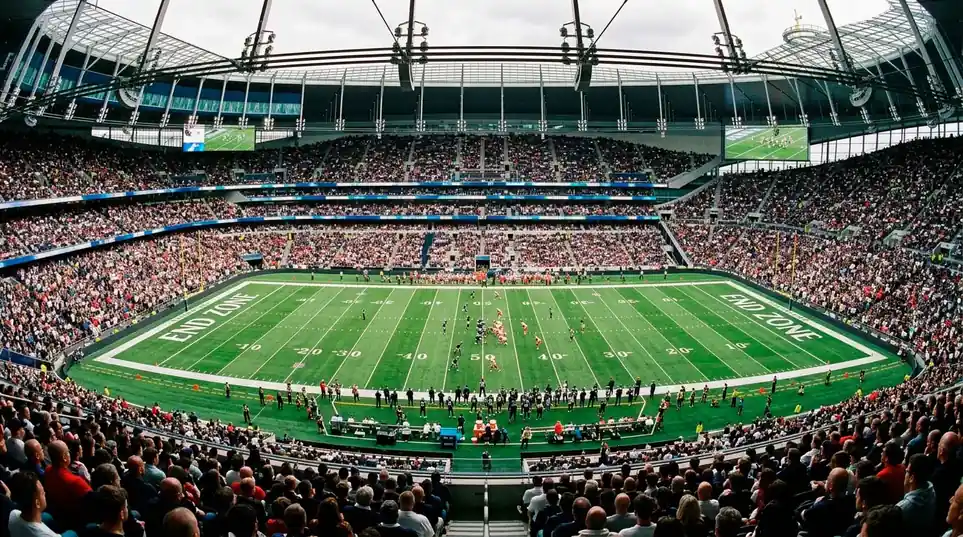
The London Games slate is a particularly good hunting ground for this kind of analysis. With the international schedule expanded to a record seven games in 2025 and London hosting three of them, the matchups produce small samples where the pricing engine has less data to work with, and where careful matchup-specific analysis can produce real edges. The flip side is that the markets carry their full overround anyway, so you’re still paying the bookmaker tax even when you find a real edge. My broader guide to NFL prop bets at UK books covers the full landscape of player and team props if you want to see touchdown scorer markets in context.
Why are first touchdown scorer prices typically 10x higher than anytime?
Because the success window is dramatically narrower. Anytime touchdown scorer pays on any of the four to seven touchdowns typically scored in an NFL game; first scorer pays on only one specific touchdown — the very first one. Roughly speaking, if your player has a one-in-five chance of scoring at all, they have closer to a one-in-fifty chance of scoring first specifically, because the first-touchdown opportunity is a single drive against a field of ten or more plausible scorers. The price ratio of roughly 8 to 12 times reflects this narrower window.
Does a quarterback rushing touchdown count for an anytime market?
Yes. Anytime touchdown scorer markets pay on any touchdown scored by your player, whether through receiving, rushing, or any offensive scoring play. A quarterback who scrambles in from five yards out for a touchdown cashes anytime tickets on themselves. What does not count is a two-point conversion, which is not technically a touchdown, and any defensive scoring play by the player, which falls under different markets.
Created by the ”nfl Betting ods” editorial team.